
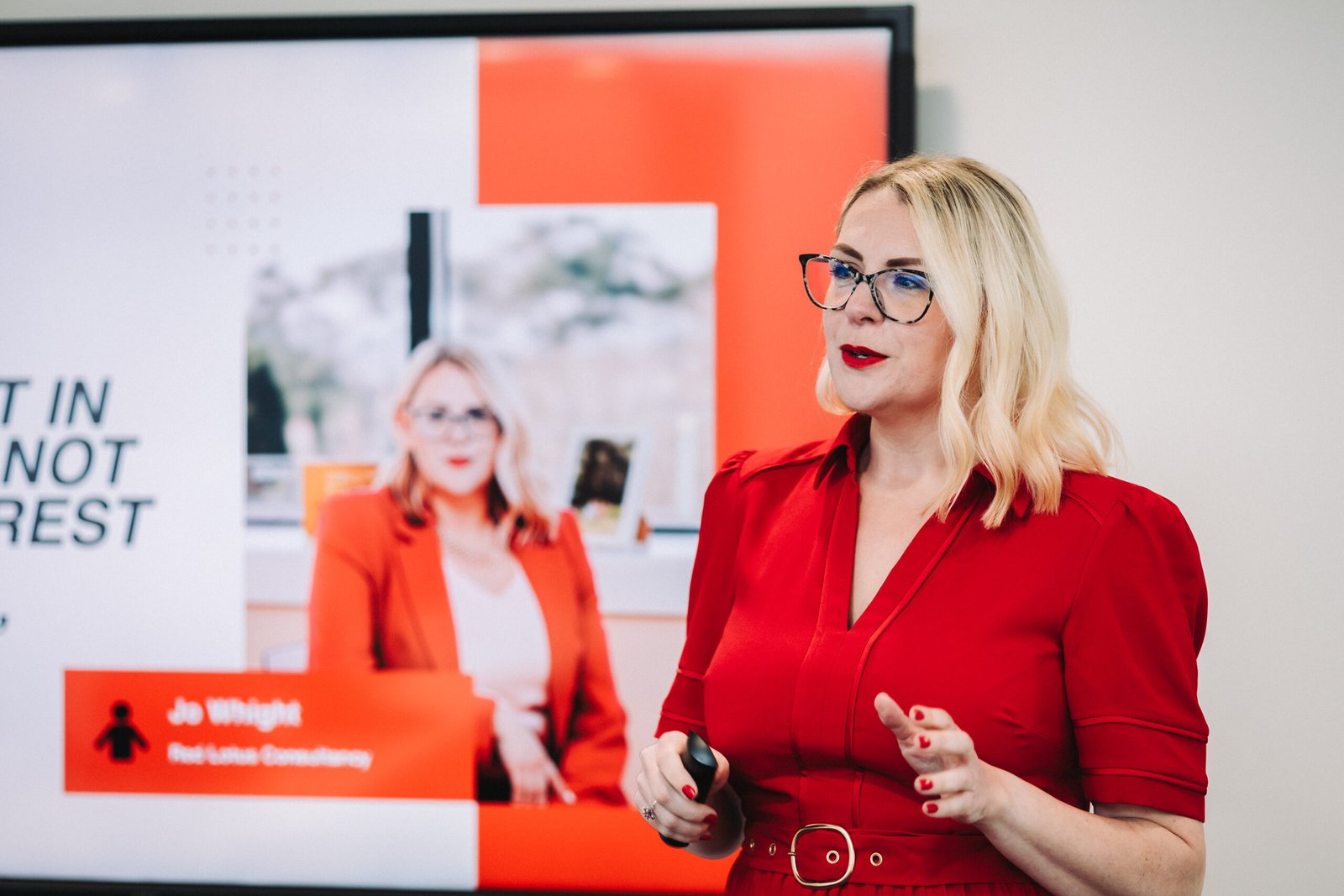
Would you rather spend £30k on an external hire, or £10k to develop someone already in your business?
95% of I asked said they’d prefer to develop and promote people internally. I expected 100% to be honest.
And yet I’ve been part of enough conversations and I suspect you have too, to know that when a key role becomes vacant and the pressure is on, the conversation almost always turns to the market first. Not because leaders don’t believe in their teams, but because the need to hire someone urgently becomes the priority.
That’s what I want to talk about.
There’s a gap between what we believe and what we do
It’s easy to frame this as short-termism or a failure of will. I don’t think that’s the issue.
Most executive teams in financial services genuinely want to develop their people. They believe in it. They say so in town halls, strategy documents, values frameworks and they genuinely mean it.
The problem is the systems sitting underneath those beliefs don’t make it easy to act on them.
When a critical role opens up, the question that follows almost by reflex is “who can we find?” rather than “who do we already have?” And often, the honest answer to the second question is: we don’t know. Not properly. We have a sense. We have some names. But we don’t have the data or the clarity to back an internal candidate with confidence, particularly when the stakes are high.
So, the external hire doesn’t win because it’s better. It wins because it’s more certain. And certainty, under pressure, counts for a lot.
The issue isn’t a shortage of good people. It’s a shortage of visibility into those people and their capabilities. That’s a system problem, not a people problem.
The numbers make the case better than I can
The evidence here isn’t subtle.
- External hires cost 18% more than internal ones and are 21% more likely to leave within the first year. Apprenticeship College UK, 2025
- 94% of employees say they’d stay longer at a company that genuinely invests in their development. AIHR / Axonify, 2024
- Employees stay 41% longer at organisations with high internal mobility. LinkedIn Global Talent Trends Report
- UK employer investment in training fell 29.5% between 2022 and 2024 from £59bn to £53bn while skills gaps widened. Talent Finance UK, 2025
That last one is worth sitting with for a moment. Skills gaps are widening and our collective response has been to cut the investment that would close them, while increasing reliance on a talent market that is getting more expensive and more competitive.
It’s not irrational but it does keep moving the problem forward.
Why this keeps happening – it’s not as simple as “short-termism”
Financial services right now is genuinely hard to lead in. Regulatory pressure, cost scrutiny, digital transformation, hybrid working, retention challenges and leaders already stretched managing the operational weight of all of it.
In that environment, talent conversations get crowded out. Not deliberately, but the urgent displaces the important, and before long you’re filling vacancies rather than building pipelines. Reacting to the people leaving rather than investing in the people staying.
And the thing that makes this particularly hard to break is that reactive hiring works in the short term. The role gets filled. The pressure lifts. But the underlying issue, that you couldn’t confidently identify internal readiness in the first place, hasn’t moved an inch.
Research from the World Management Survey found that firms in the top quintile for talent management practices significantly outperform those at the bottom on both productivity and profitability. But those firms aren’t just thinking about talent more strategically. They’ve built the infrastructure to translate that thinking into decisions.
On succession planning – an honest conversation
Succession plans exist in most organisations. The question is how many of them work.
There’s a difference between a succession document and a succession system. One gets updated once a year and filed. The other tells you, right now, who is genuinely ready, who is nearly there, and where your organisation is most exposed if someone walks out next Monday.
Very few organisations have a succession system. Which means that when the moment comes to make a talent decision, the confidence isn’t there to back the internal candidate. The data is out of date. The readiness mapping hasn’t been done. And under those conditions, it’s entirely rational to reach for an external search even if, deep down, everyone suspects there’s someone inside who could do the job.
This has long-term implications. But it is entirely solvable, if it’s treated with the operational priority it deserves.
There’s a harder conversation underneath all of this
So far, I’ve talked about this as an efficiency problem. A visibility problem. A systems problem.
But there’s something else going on and it’s worth naming directly.
When organisations default to external hiring, they don’t just reach into the market at random. They reach into their networks. The people who get called, referred, and recommended are disproportionately the people who already look like the leadership team. And in financial services, that leadership team has a very particular profile.
- 89% of CEOs in UK financial services come from professional backgrounds compared to 37% of the wider UK working population. The Bridge Group, ‘Who Gets Ahead and How’
- Employees from professional backgrounds in FS are 43% more likely to reach senior level than their working-class peers. City of London Socio-Economic Diversity Taskforce, 2022
- People from lower socio-economic backgrounds take 25% longer to progress to senior roles despite no link with poor performance. Progress Together, 2023
- Nearly 50% of new entrants into UK financial services come from fee-paying or selective schools, compared to 18% of the wider population. WIBF, 2025
FS firms are making decisions about customers, products, risk, strategy with leadership teams that reflect a narrow slice of the population they serve.
And meanwhile, inside those same organisations, there are people with the capability, the drive, and the potential to step up. People who have navigated real complexity in their lives. People who understand communities their employers are trying to reach. People who are often being overlooked not because they lack talent but because they lack access, visibility, and the kind of sponsorship that others get given organically.
The system isn’t just failing to see them. In many cases, it isn’t even looking.
Missed talent is missed profit. And in financial services right now, the cost of that is no longer just cultural – it’s competitive.
The UK economy loses an estimated £19bn in GDP every year due to low social mobility. Closing the gap could deliver over £1.8bn in profit to UK businesses. Firms with stronger socio-economic inclusion deliver 1.4 times the profits of their peers.
What actually needs to shift
I’m not going to give you a five-step framework here. Those tend to be the things that get read once and filed alongside the succession plan.
But there are a few questions worth sitting with honestly at a senior level.
Is talent genuinely on the executive agenda, not just as an HR update, but as a business conversation? What capability does the organisation need in the next three to five years? Where are the real gaps? And who is being developed and who is being overlooked?
Is your succession process giving you the confidence to actually use it? If the honest answer is no, if you wouldn’t stake a critical appointment on what it’s currently telling you, it’s worth fixing before the next vacancy lands.
And is your investment in development being treated as a cost, or as a capability-building decision? The organisations that consistently outperform on talent don’t spend more than everyone else. They spend more intentionally. They know what they’re building and why.
Two things we know make a difference
Tools like TalentMapper are starting to address the visibility gap, giving organisations live succession data, skills mapping and readiness insight that makes the internal investment decision a confident one rather than a hopeful one. When you can see your talent clearly, backing it becomes straightforward.
But visibility alone isn’t enough if the talent you’re failing to see is never given the right conditions to grow.
That’s the problem that Untapped, a 12-month leadership accelerator developed by Jo Whight and Paul Scadding, is designed to tackle head on. Not a diversity programme in the traditional sense and emphatically not a tick-box exercise.
Untapped works with high-potential people from low-income backgrounds who are already inside your organisation, giving them the coaching, sponsorship, career capital, and leadership skills to step into the roles they’re capable of and giving organisations the pipeline so they can’t reduce expensive externally hires.
The commercial case stacks up. For a cohort of 25 participants, the programme projects tangible ROI of 1.3 to 1.7 times. That’s before you factor in the longer-term pipeline value, the cultural shift, or what it means for an organisation’s ability to attract talent that wants to work somewhere that takes this seriously.
Because that matters too. The employers who will win the talent competition in financial services over the next decade aren’t necessarily the ones paying the most. They’re the ones with reputations for actually developing people.. all of their people regardless of their background or diversity characteristics.
To close
95% of people voted to develop internally. That’s not a surprise, it’s the right answer and most people know it.
The question worth asking isn’t whether we believe in developing our people. It’s whether our systems make it easy enough to actually do it or whether they make the external hire the path of least resistance every time.
And it’s whether the people with the most to offer inside our organisations are actually being seen. Or whether the way we hire, promote and develop talent is narrowing our leadership pipelines rather than widening them.
Both problems are solvable. The talent is already there. The question is whether we’re building the conditions to find it.
SOURCES:
CIPD Resourcing & Talent Planning Report 2024 | LinkedIn Global Talent Trends | World Management Survey 2023 | Apprenticeship College UK 2025 | Talent Finance UK 2025 | AIHR / Axonify 2024 | The Bridge Group — ‘Who Gets Ahead and How’ | City of London Socio-Economic Diversity Taskforce 2022 | Progress Together 2023 | WIBF Social Mobility Report 2025 | Demos — ‘The Opportunity Effect’ 2024 | JAM People Consulting — Talent Strategy in Financial Services 2026